AI SaaS SEO Case Study: From 0 to 20K Traffic Per Month
This is an SEO case study of how I managed to rank my AI SaaS client website starting from scratch (new website), bringing it all the way to generating over 20,000 visitors per month.
Like any other of my case studies, I won’t reveal the website and keywords for security and privacy reasons. But in this article, you will find some of my overview process of how I went about achieving the results, along with various screenshots as proof.
Project Background
The client runs a SaaS website in the AI companion industry, which is one of the most competitive spaces in the SEO space due to many big players dominating the space, Google’s stricter algorithm, and various kinds of negative SEO attack. The client reached out to me as soon as they got the site built.
Challenges
Here are a few challenges faced while working on the project:
- Starting from scratch: The site was new, and due to the highly competitive nature of the industry, it would require a whole lot of effort and budget to be able to rank this site well enough on Google
- Big players dominating the search results: There had already been many big competitors dominating the search results in this space, many of which had been very well established and have huge monthly budget for their SEO.
- More limited budget than needed: The company was newly established and hence had limited budget compared to what was really needed to get great results from the campaign.
The Campaign
Here are the overviews of how I approached the campaign:
Technical Optimization
The first step was to establish a strong technical foundation to the website. Since the site was custom-built by the client, I audited the site and advised them on what needed to be done.
Some of the things I recommended them are canonical tag implementation, friendlier site structure, no-indexing, and blocking user-only pages to reduce crawl budget on unnecessary pages and bloat index.
On-Page Optimization
Next up is to focus on the on-page obsessively. What I mean by “obsessively” here is to optimize each and every detail to the tee.
This includes things like:
- Heading (h1,h2 & h3) optimization
- Keyword research, content creation and optimization
Keyword research was carried out by looking at the competitor websites, general keyword ideas, and upcoming trends. We made sure to layout topical maps and templates, mainly focusing on commercial pages to capture long-tail and easier keywords, along with some blog articles to help establish site topical relevance. - Sentence-level optimization using semantically relevant keywords:
When it comes to each page content optimization, I made sure everything was done to the details. First thing was making sure that each sentence is properly optimized using semantically relevant keywords based on reverse engineering the competitors and using a proprietary tool that I created. You can use on-page tools like Surfer-SEO to help with the process. This step is applied to the homepage (which targets the main keyword) and other services. - Keyword count and variation optimization:
Making sure that I have used the right frequency of each keyword on the page. For example, the word “Companion”, I made sure to check the competitors’ average and see how many times I should use this word. You can again, use tools like Surfer SEO, but there’s really no hard rule for this. I’d like to keep it a little lower than the average to avoid over-optimization. - Topic research and coverage
For templated pages, I make sure to have a template of topics that are important based on research from AI content outline, the competitors, and the client’s unique selling angles. For blog articles, I made sure to cover each article deep enough without going too far off the topic. - Internal linking
Lastly, after all the page creation and optimization steps were carried out, I also made sure to do proper internal linking – connecting from one page to another using relevant anchor texts and keeping in mind the quantity.
Off-Page Optimization
Once the on-page of the site is ready, the next thing is to start looking into off-page factors.
- Brand building:
The first step in the off-page SEO that I asked the client to do was to start building a brand and generating traffic from various sources. Due to the nature of the business that doesn’t allow for advertisement, the best sources of promotions are Reddit and an affiliate program, which the client set up as a leverage to help attract more mentions and links. - Link building:
Link building was one of the key drivers for the campaign. During the initial phase to help the site get out of Google Sandbox, I focused on acquiring links from high-quality guest posts, industry-relevant websites, and directory-type sites that allow us to add a listing in exchange for affiliate commission/monthly subscription. Later down the line, I also focused on adding high-quality, strong PBNs to increase the site authority and nudge some of the difficult keywords up the ranking. - Viral traffic campaigns:
Throughout the months of working on the site, I also schedule viral traffic campaigns to periodically boost rankings for various pages across the site. This helps speed up the ranking process and amplify all of other things that have been done. To learn more about how this works, check out my viral traffic for SEO.
Results
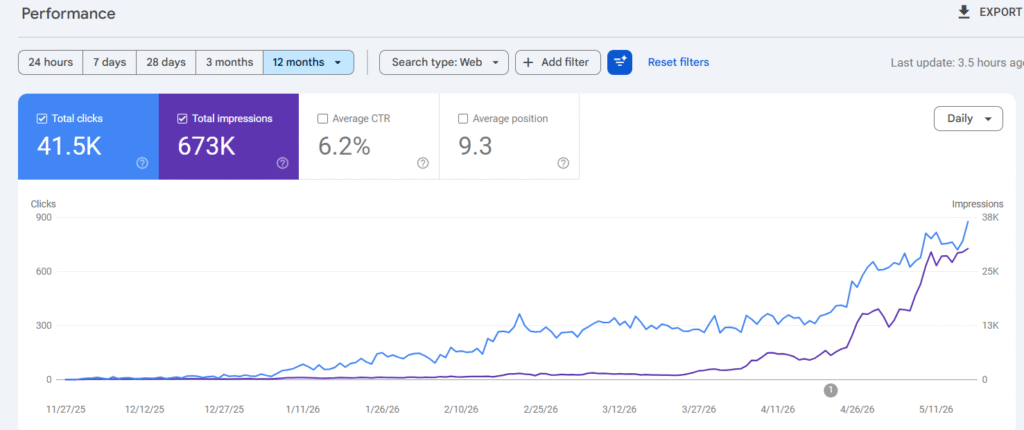
After about 5 months into the campaign, the site quickly grew the daily clicks from 4-5 to now averaging between 750-850 and growing. The site hugely took off after the Google April Core Update as you can see from the graph
Want To Get Results Like This?
Are you looking for either an SEO service or 1-on1 SEO coaching? Get in touch with me today and let’s see how I can help you.

![[Case Study] How I Helped This Affiliate Site Triple Their Traffic & Rankings](https://techjackie.com/wp-content/uploads/2022/04/Coupon-Referral-Affiliate-SEO-Coaching-Case-Study.jpg)
![How To Use Google Disavow Tool [Case Study + Guide]](https://techjackie.com/wp-content/uploads/2020/07/How-To-Use-Google-Disavow-Tool-Case-Study-Guide.jpg)
![[Case Study] How I Helped This Local CBD Site Quickly Grew New Site Traffic](https://techjackie.com/wp-content/uploads/2022/09/local-CBD-seo-case-study.jpg)