
CBD SEO Case Study: 30k Organic Traffic in 3 Months

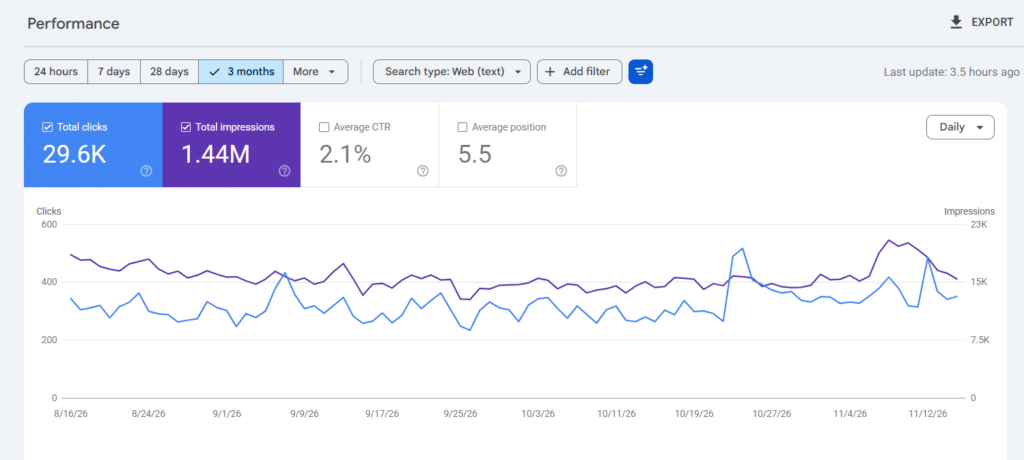
This is an SEO case study of how I managed to generate 30,000 organic traffic in the last 3 months, while maintaining keyword rankings for many of the comemrcial terms for a CBD e-commerce website.
Like any other of my case studies, I won’t reveal the website and keywords for security and privacy reasons. But in this article, you will find some of my overview process of how I went about achieving the results along with various screenshots proof.
Project Background
The client runs a CBD e-commerce website in Thailand and approached me to help me improve rankings for some of the competitive keywords and overall performance of the site. This is a WordPress website that has been established for a while and has been doing quite well overall but still lacked the competitive edge over other major players in the industry.
Challenges
The main challanges working on this project were:
- Very high competition: There are many strong competitors ranking in the space dominating the niche with much bigger resources compared to my client.
- Large site with many cleanups: The site is pretty large with many things to clean up eg: technical, content and more.
The Campaign
Here are the overviews of how I approached the campaign:
Technical Optimization
The first step was to perform a technical audit since it’s the most common issue with any e-commerce website.
I used Screaming Frog to crawl and weed out basic technical issues such as orphan pages, 404 pages, obvious duplicate pages, canonicalization and more. This is then combined with the use of Google Search Console and manual checking to combine near-duplicate pages, fix internal links and fixing keyword cannibalizations via 301 redirects.
On-Page Optimization
Next up is to focus on the on-page of the website, mainly on the category pages.
This includes things like:
- Heading (h1,h2 & h3) optimization
- Category page creation and optimization:
Since the majority of traffic will go to product category pages, I prioritized creating new sub-category pages via keyword research to capture extra long-tail keyword oppornuties to help solidfy topical clusters, and re-optimize existing ones. - Sentence-level optimization using semantically relevant keywords:
By making sure that each sentence is properly optimized using semantically relevant keywords based on reverse engineering the competitors and using a proprietary tool that I created. You can use on-page tools like Surfer-SEO to help with the process. This step is applied to each category pages for maximum on-page relevance. The product page wasn’t really the priority here since all of the products are basically a list of their specifications that the client already does some basic SEO for. - Keyword count and variation optimization:
Making sure that I have used the right frequency of each keyword on the page. For example, the word “CBD”, I made sure to check the competitors’ average and see how many times I should use this word. You can again, use tools like Surfer SEO, but there’s really no hard rule for this. I’d like to keep it a little lower than the average to avoid over-optimization. - Blog creation
Besides creating and optimizing new category pages, I also created a couple of blogs to help capture additional traffic and support the category pages further, following the same style of optimization (keyword count and sentence-level optimization) - Internal linking
Lastly, after all the page creation and optimization steps were carried out, I also made sure to do proper internal linking – connecting from one page to another using relevant anchor texts and keeping in mind the quantity.
Off-Page Optimization
Once the on-page of the site is ready, the next thing is to start looking into off-page factors.
Here are some of the things I did:
- Build targeted backlinks to certain clusters
First thing was to prioritize certain keyword clusters (both new and old ones) that started showing potential of ranking well and building backlinks to them. The kind of backlinks used were some high-quality PBNs for power and guest posts for quality and relevance. - Viral Traffic
Next was to send viral traffic to help push the rankings for pages already near page 1 to get clicks and user siganls. Viral traffic is a strategy I’ve been using for the past 5 years as icing on the cake to help amplify the overall SEO signals and rank keywords faster. You can learn more about the viral traffic service here.
Want To Get Results Like This?
Are you looking for either an SEO service or SEO coaching? Get in touch with me today and let’s see how can I help you.